How to Improve Employee Accountability in a CA Firm: A Practical Guide for Partners
Running a CA firm is not just about managing clients, deadlines and compliance work. It is also about managing people.
A partner assigns work to an employee. The employee says they will complete it. A few days later, the partner asks for an update. The employee says the work is in progress. Another follow-up is needed. Eventually, the deadline approaches, and the partner discovers that an important step is still pending.
This cycle is familiar in many growing CA firms.
The problem is not necessarily that employees are careless or unwilling to work. Often, the firm has no consistent system for assigning responsibility, recording progress, identifying delays and escalating issues.
When accountability depends on a partner remembering to ask, the partner becomes the firm's follow-up system.
A better approach is to build a workplace where responsibilities are clear, progress is visible and pending work receives timely attention.
This guide explains how CA firms can improve employee accountability through practical processes, without creating unnecessary bureaucracy or micromanaging their teams.
1. Why employee accountability becomes difficult as a CA firm grows
A small CA practice can sometimes function through direct conversations. The partner knows every employee, remembers most client assignments and can ask for updates personally.
But as the firm grows, this informal approach becomes harder to maintain.
Consider a firm with 20 employees and 300 active clients. Work may include:
Monthly GST compliance.
Quarterly TDS returns.
Income tax return preparation.
ROC compliance.
Audit assignments.
Client document follow-ups.
Accounting and bookkeeping.
Internal reviews and approvals.
Each employee may be handling multiple clients and assignments simultaneously.
The partner cannot realistically remember the status of every task.
Common problems begin to appear:
1. Unclear ownership
Two employees assume the other person is responsible for completing a task.
2. Delayed progress updates
Managers discover problems only when they ask for an update or a deadline is approaching.
3. Work gets lost in conversations
An assignment is communicated through WhatsApp, discussed in person and later forgotten because nobody records its current status.
4. Managers spend too much time following up
Instead of reviewing work, advising clients or developing the firm, senior employees repeatedly ask, "What is the status?"
5. Performance becomes difficult to evaluate
A manager may know that someone appears busy but cannot easily identify their completed work, pending assignments or recurring bottlenecks.
The solution is not simply to tell employees to become more responsible. It is to create a system in which responsibility is measurable.
2. Define accountability properly
Employee accountability does not mean monitoring every movement or asking employees for updates every hour.
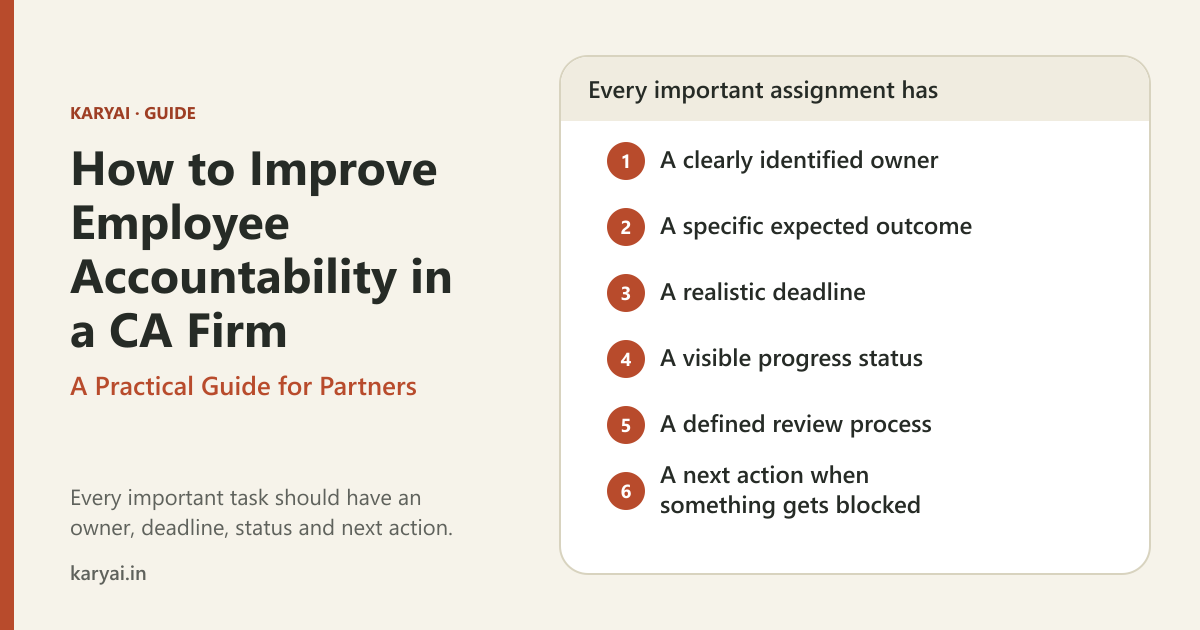
It means that every important assignment has:
A clearly identified owner.
A specific expected outcome.
A realistic deadline.
A visible progress status.
A defined review process.
A next action when something gets blocked.
For example, consider a GST assignment.
A weak instruction would be:
"Please complete the GST work for ABC Traders."
A more accountable assignment would be:
Client: ABC Traders
Work: Monthly GST return preparation
Owner: Rahul
Deadline: 18th of the month
Current status: Documents received
Next action: Complete reconciliation
Reviewer: Senior accountant
Escalation: Inform the manager if information is missing or the internal deadline is at risk
The second instruction makes responsibility much clearer.
The objective is not to make every assignment complicated. It is to make the next action obvious.
3. Give every task one directly responsible owner
One of the most common management mistakes is assigning responsibility to a group rather than an individual.
For example:
"Rahul and Priya will handle this client."
Who is responsible for the next step?
If the work is delayed, who should the manager approach?
A better approach is to assign one directly responsible owner, even when multiple employees contribute.
For every important task, record:
| Field | Example |
|---|---|
| Client | ABC Traders |
| Assignment | GST reconciliation |
| Responsible owner | Rahul |
| Supporting employee | Priya |
| Deadline | 18th |
| Reviewer | Senior accountant |
| Status | In progress |
| Next action | Resolve missing entries |
The responsible owner coordinates the assignment. Supporting employees contribute to the work, and the reviewer checks the output.
This avoids shared responsibility becoming nobody's responsibility.
4. Create a simple status system everyone understands
Employees should not have to write long explanations every time a manager asks for progress.
A standard status vocabulary makes updates faster and more useful.
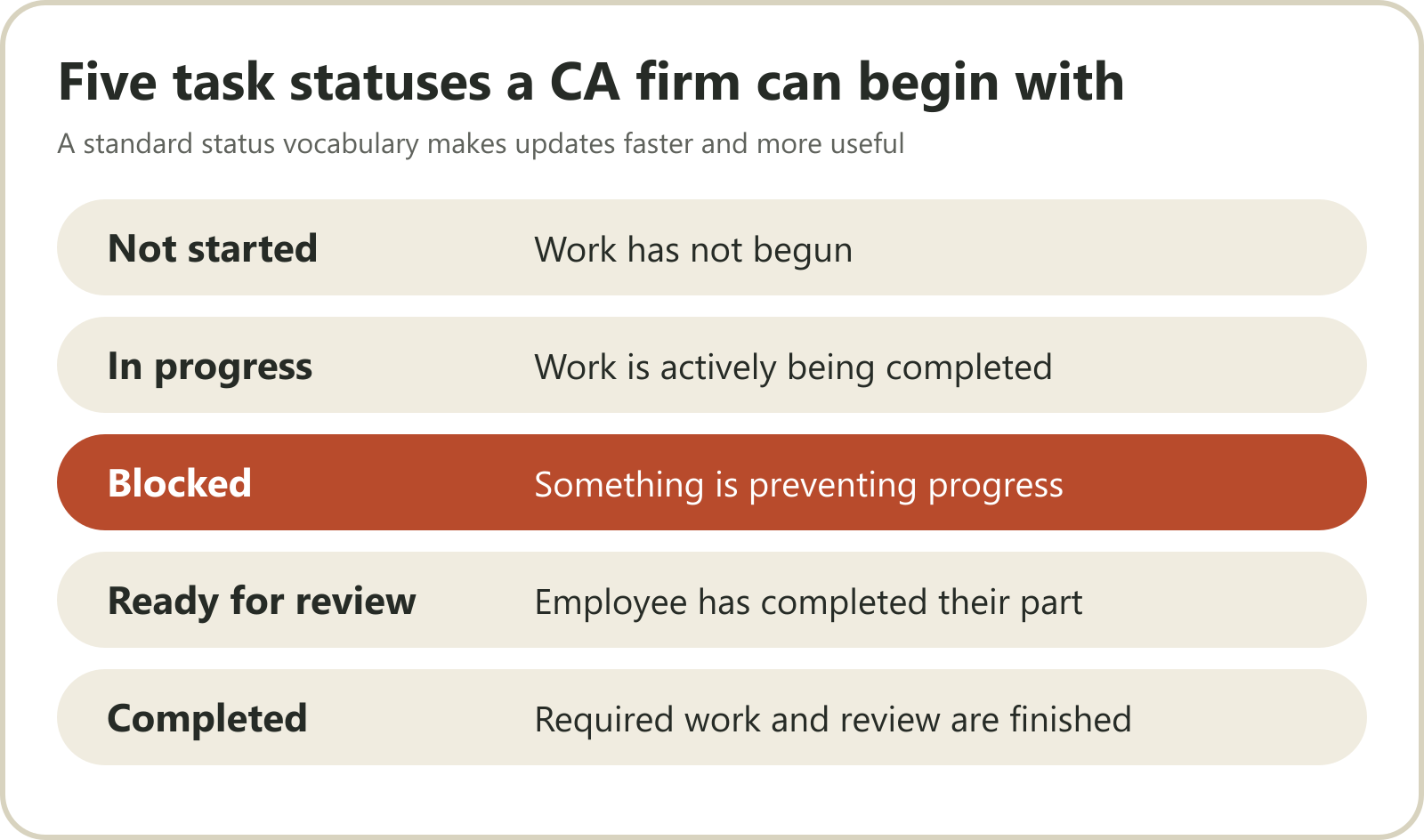
A CA firm can begin with five statuses:
| Status | Meaning |
|---|---|
| Not started | Work has not begun |
| In progress | Work is actively being completed |
| Blocked | Something is preventing progress |
| Ready for review | Employee has completed their part |
| Completed | Required work and review are finished |
The most important status is Blocked.
A task marked "Blocked" should also explain:
What is missing?
Who can resolve it?
What is the next action?
When should it be followed up?
For example:
"ABC Traders — GST reconciliation blocked because purchase data is missing. Waiting for client documents. Rahul to follow up tomorrow."
This gives the manager something actionable instead of another vague status update.
5. Build a daily update habit instead of constant supervision
A partner should not need to ask employees for updates throughout the day.
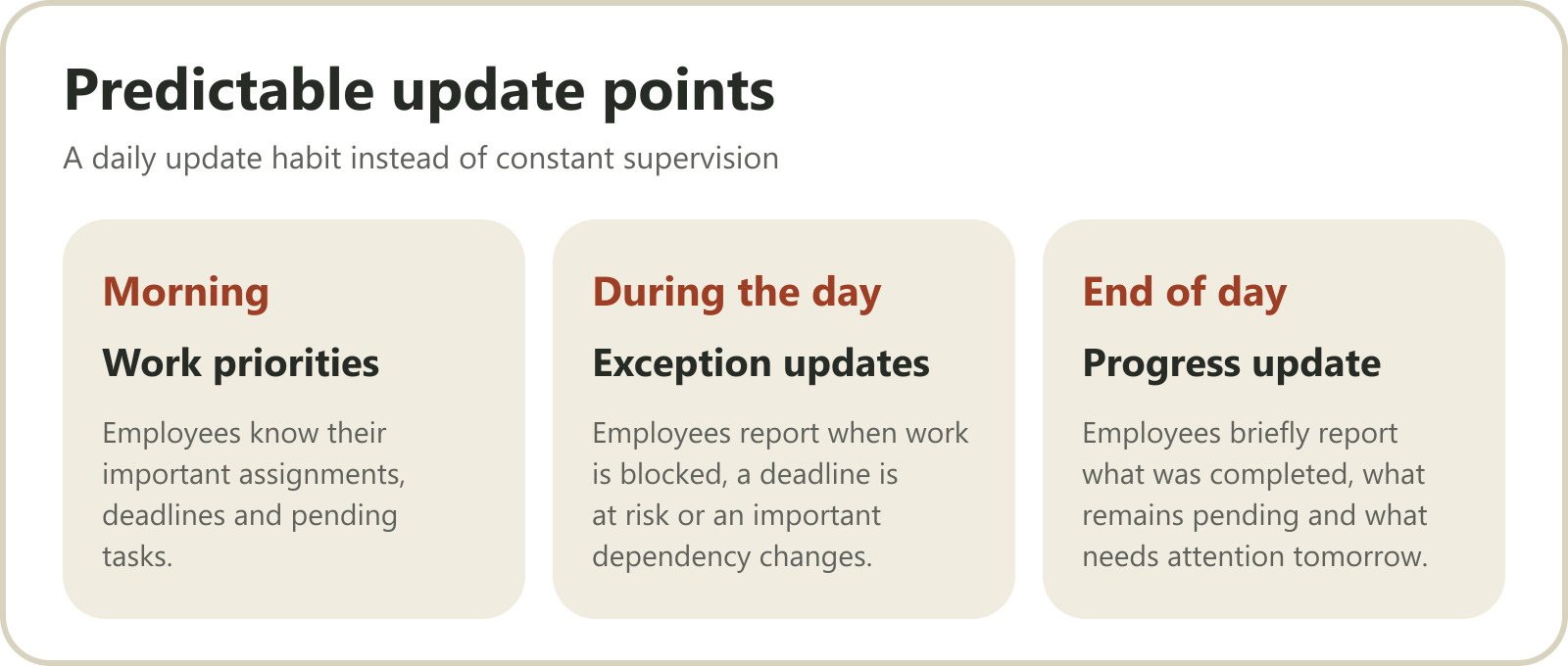
A better approach is to establish predictable update points.
For example:
Morning: Work priorities
Employees know their important assignments, deadlines and pending tasks.
During the day: Exception updates
Employees report when work is blocked, a deadline is at risk or an important dependency changes.
End of day: Progress update
Employees briefly report what was completed, what remains pending and what needs attention tomorrow.
A useful daily update can be as simple as:
Completed: ABC Traders GST reconciliation.
In progress: XYZ Ltd. TDS working.
Blocked: PQR Pvt. Ltd. documents not received.
Next action: Follow up with client tomorrow.
The goal is to create a reliable information flow, not another reporting burden.
Avoid asking employees to submit long daily reports that managers never read.
6. Make follow-ups systematic
This is where many CA firms lose a significant amount of management time.
A task is assigned. The employee forgets to update it. The manager sends a message. The employee replies later. The manager then has to remember to follow up again.
The cycle repeats.
A systematic follow-up process should answer four questions:
When should the employee receive a reminder?
What should happen if there is no response?
When should a delayed task reach the manager?
Who is responsible for resolving a blocked assignment?
For example:
| Situation | Recommended action |
|---|---|
| Task assigned | Employee receives the assignment |
| Progress update due | Employee receives a reminder |
| No response | Follow-up is sent |
| Work is blocked | Employee explains the blocker |
| Deadline is at risk | Manager is informed |
| Work is ready | Reviewer receives it |
| Work is approved | Task is marked complete |
The frequency should depend on the urgency of the work. A daily reminder may be appropriate for an urgent assignment, while a longer interval may be sufficient for routine work.
The principle is simple: follow-ups should be part of the process, not dependent on someone's memory.
7. Separate employee productivity from employee busyness
An employee who appears busy is not necessarily productive.
Similarly, an employee handling fewer assignments may be working on more complex or time-consuming work.
CA firm managers should avoid judging performance only by the number of tasks assigned or completed.
Instead, consider multiple indicators.
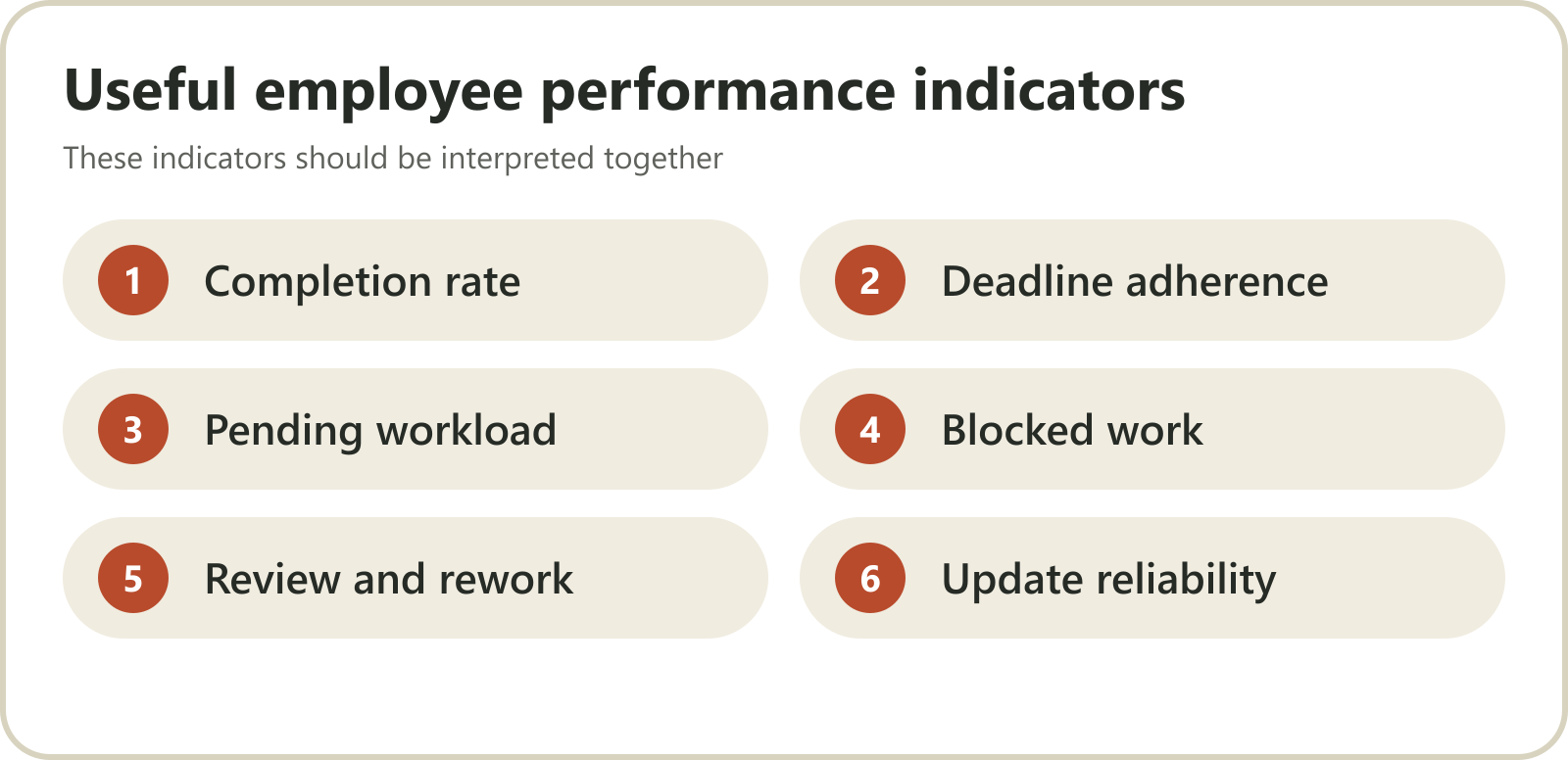
Useful employee performance indicators
1. Completion rate
What percentage of assigned work was completed within the agreed period?
2. Deadline adherence
How consistently does the employee meet internal deadlines?
3. Pending workload
How many active assignments are currently pending with the employee?
4. Blocked work
How much work is waiting for documents, clarification, client responses or internal approvals?
5. Review and rework
How frequently does submitted work require substantial correction?
6. Update reliability
Does the employee communicate progress and blockers without repeatedly being asked?
These indicators should be interpreted together.
For example, a high number of pending tasks may indicate poor execution, but it may also indicate excessive workload, difficult clients or insufficient resources.
A good manager investigates the reason instead of immediately blaming the employee.
8. Introduce a weekly employee performance review
Daily updates help managers understand what is happening. Weekly reviews help them understand why it is happening.
A 20–30 minute review can be enough for a team or department.
Review these five areas:
| Review area | Questions to ask |
|---|---|
| Completed work | What was successfully completed? |
| Delayed work | Which assignments missed their internal deadlines? |
| Blockers | What prevented progress? |
| Workload | Is work distributed fairly? |
| Improvement | What needs to change next week? |
Do not turn this meeting into a session where employees are simply criticised for pending work.
The purpose is to identify operational problems.
For example:
If one employee repeatedly has too many assignments, redistribute work.
If multiple tasks are blocked by client documents, improve the document follow-up process.
If work repeatedly fails review, provide training or clearer instructions.
If deadlines are unrealistic, revise the internal planning process.
Accountability works best when employees are given both responsibility and the resources to fulfil it.
9. Use technology to reduce manual follow-ups
Once a firm has a clear accountability process, technology can make it easier to maintain.
Many firms already use WhatsApp to communicate with employees. The difficulty is that conversations are not automatically the same as structured management records.
A message may contain an assignment, a progress update or a blocker, but the manager still needs to understand what it means for the overall workflow.
Useful software should help a CA firm:
Assign tasks with owners and deadlines.
Track progress against each client.
Send reminders for pending work.
Record employee updates.
Highlight overdue and blocked assignments.
Maintain review and approval steps.
Give managers a consolidated view of work.
The important question is not how many features a software platform has.
It is whether the software reduces the amount of manual coordination required to keep work moving.
Why WhatsApp-first workflows can improve adoption
Introducing another application does not automatically improve employee accountability.
If employees already communicate through WhatsApp, a system that requires them to open a separate application repeatedly may create another adoption challenge.
A WhatsApp-first workflow can reduce this friction.
For example:
A manager assigns a task.
The employee receives the assignment through WhatsApp.
The system follows up when an update is due.
The employee replies in natural language.
The reply is converted into a structured task update.
The manager sees progress through a dashboard.
This makes communication part of the workflow instead of leaving it scattered across conversations.
10. How Karyai helps CA firms manage employee accountability
Karyai is an AI-powered practice management platform built for Indian professional firms, including CA and CS firms.
Its approach is based on a simple idea: employees should be able to communicate and update work through WhatsApp, while partners and managers should have a consolidated view of what is happening.
Instead of depending entirely on managers to chase employees, Karyai supports the follow-up process.
Its relevant capabilities include:
AI employee follow-ups on WhatsApp
Karyai follows up on pending tasks and reminds employees to share progress.
Task assignment and tracking
Tasks can be assigned with owners, clients and deadlines, with progress recorded against the work.
Structured employee updates
Employee replies can be converted into task updates and work logs.
Manager dashboards and summaries
Managers get a clearer view of completed, pending and attention-required work.
Reviews and approvals
Work requiring a second look can go through a review process before it is marked complete.
Work logs
Employees can record time against client work, helping managers understand where recorded hours are going.
Karyai also supports recurring client projects, GST invoicing, attendance and other practice operations.
It is already used inside a CA firm with 43 employees across 7 cities, where more than 100 client projects are created every month.
Importantly, Karyai helps organise compliance work and employee coordination. It does not calculate tax, prepare statutory returns or file GST, TDS, ITR or ROC returns. Professional review and filing remain with the CA firm.
You can explore Karyai's practice management software for CA firms or view its task management features.
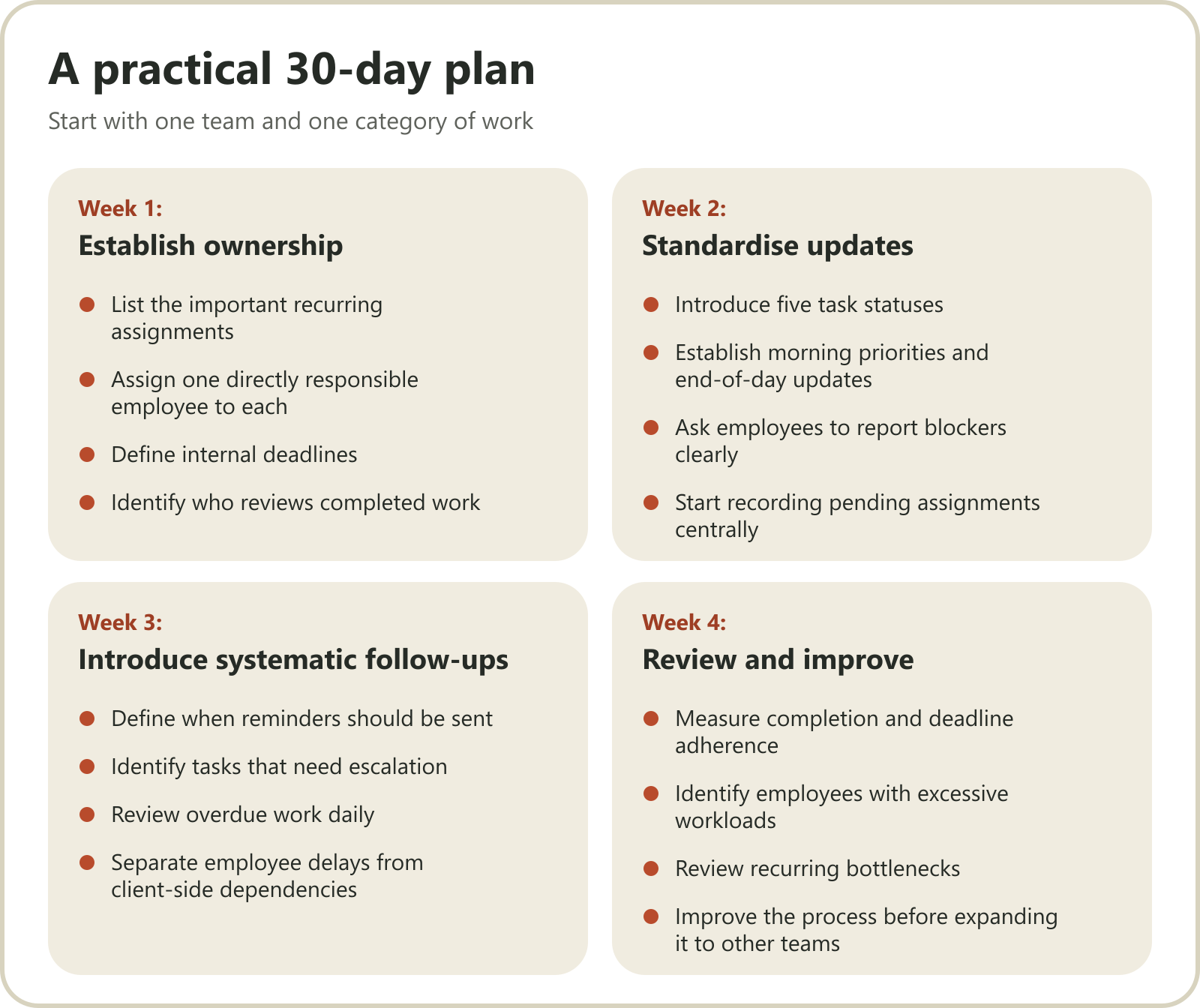
11. A practical 30-day plan to improve accountability in your CA firm
You do not need to change the entire firm's working process overnight.
Start with one team and one category of work.
Week 1: Establish ownership
List the important recurring assignments.
Assign one directly responsible employee to each.
Define internal deadlines.
Identify who reviews completed work.
Week 2: Standardise updates
Introduce five task statuses.
Establish morning priorities and end-of-day updates.
Ask employees to report blockers clearly.
Start recording pending assignments centrally.
Week 3: Introduce systematic follow-ups
Define when reminders should be sent.
Identify tasks that need escalation.
Review overdue work daily.
Separate employee delays from client-side dependencies.
Week 4: Review and improve
Measure completion and deadline adherence.
Identify employees with excessive workloads.
Review recurring bottlenecks.
Improve the process before expanding it to other teams.
At the end of 30 days, evaluate whether managers are spending less time chasing updates and whether the firm has better visibility into its work.
The objective is a sustainable management process, not more reporting.
12. Common mistakes to avoid
Even a well-designed accountability system can fail if it is implemented poorly.
Mistake 1: Micromanaging employees
Constantly asking for updates creates frustration. Use agreed update points and exception-based follow-ups.
Mistake 2: Assigning unrealistic deadlines
Employees cannot be accountable for deadlines that ignore workload, complexity and client dependencies.
Mistake 3: Measuring only the number of completed tasks
Task quantity does not always reflect quality, complexity or actual contribution.
Mistake 4: Ignoring blocked work
A task waiting for client information should not be treated the same as a task ignored by an employee.
Mistake 5: Using too many tools
If employees must update several trackers, they may stop maintaining all of them consistently.
Mistake 6: Reviewing performance only when something goes wrong
Regular feedback helps identify problems before they become serious.
Mistake 7: Automating without defining the process
Software cannot fix unclear ownership or poorly defined responsibilities. Establish the workflow first, then automate the repetitive parts.
Conclusion: Build a system where accountability does not depend on the partner
A CA firm's growth should not mean that its partners spend more and more time asking employees for updates.
As the team expands, the management process must become more structured.
Every important task should have an owner, deadline, status and next action. Employees should have a simple way to communicate progress. Managers should be able to identify delays without personally checking every assignment.
Technology can support this process by automating repetitive reminders, recording updates and bringing work into one management view.
The real goal is not to monitor employees more closely.
It is to build a firm where people know what they are responsible for, managers can trust the information they receive, and client work keeps moving even when the partner is not personally chasing every task.
Want to see how this can work in your CA firm?
Book a complimentary workflow audit and live demo with Karyai. Bring one of your existing employee workflows, and see how WhatsApp-based task assignments, AI follow-ups and management summaries can support your team.
Frequently Asked Questions
1. How can CA firms improve employee accountability?
Start by assigning one responsible owner to every important task, defining clear deadlines, standardising progress statuses and introducing regular updates. Review delayed and blocked work consistently.
2. How do CA firms track employee performance?
CA firms can track completion rates, deadline adherence, pending workload, blocked assignments, review quality and update reliability. These indicators should be evaluated together rather than used in isolation.
3. How can CA firm partners reduce employee follow-ups?
Use a central task management system with clear ownership, due dates, automatic reminders and escalation rules. This reduces the need for partners to manually ask employees for updates.
4. What is the role of technology in employee management for CA firms?
Technology can centralise assignments, record progress, send reminders, manage approvals and provide managers with visibility into pending work. It should simplify the firm's process rather than add more administrative work.
5. Can WhatsApp be used for employee task management?
Yes. A WhatsApp-based workflow can help employees receive assignments, respond to reminders and share progress through familiar conversations. A suitable system should also structure those updates so managers can track work centrally.
6. How can a CA firm manage employees working on multiple clients?
Assign tasks client-wise, identify one responsible owner for each assignment, set internal deadlines and review workload across employees. A consolidated dashboard can help managers identify overloaded team members and pending work.
7. What is the difference between employee monitoring and employee accountability?
Employee monitoring focuses on observing activity. Accountability focuses on agreed responsibilities, expected outcomes, deadlines and transparent progress. A good management system emphasises outcomes rather than unnecessary surveillance.
8. Does Karyai help CA firms follow up with employees?
Yes. Karyai uses AI-powered WhatsApp follow-ups to remind employees about pending tasks, record their responses as structured updates and provide managers with visibility into work progress.