How to Manage Multiple Clients in a CA Firm: A Practical Client-Wise Workflow
Managing 10 clients is relatively straightforward. Managing 100 or 500 clients while coordinating employees, recurring assignments, deadlines and client expectations is an entirely different challenge.
As a CA firm grows, its biggest operational problem is often not the amount of technical work. It is maintaining visibility across the entire client portfolio.
One client may have monthly GST work. Another may require TDS returns, accounting and an annual audit. A third may have several pending assignments, while a fourth is waiting for a response from the firm's team.
Now imagine managing all of this through separate WhatsApp conversations, Excel sheets, employee reminders and personal memory.
Important information becomes scattered. Partners repeatedly ask for updates. Employees struggle to understand priorities, and management finds it difficult to identify which clients need attention.
The solution is to move from managing individual assignments in isolation to managing the entire client portfolio through a structured operating system.
In this guide, we will explain how CA firms can organise multiple clients, manage client-wise responsibilities, monitor ongoing work and build a system that continues to function as the firm grows.
1. Why managing multiple clients becomes difficult for CA firms
A CA firm does not simply manage a list of client names. It manages hundreds of relationships, services, deadlines and internal responsibilities.
Consider a firm serving 100 clients.
Its portfolio might include:
Businesses requiring monthly GST compliance.
Companies requiring quarterly TDS work.
Individuals requiring annual income tax services.
Companies requiring ROC and MCA-related compliance.
Businesses requiring bookkeeping and accounting.
Clients requiring audits and financial reporting.
Clients requiring multiple services from the same firm.
Each client may have different service requirements, internal owners, deadlines and communication needs.
As the portfolio grows, several problems become common.
Problem 1: No single view of client work
Information is spread across different spreadsheets, WhatsApp chats and individual employees.
A partner may know that a particular client has work pending but may not know exactly what is outstanding.
Problem 2: Client responsibilities are unclear
An employee may handle GST work while another handles accounting. However, nobody may have clear responsibility for coordinating the overall client relationship.
Problem 3: Recurring work gets difficult to coordinate
The firm repeatedly handles similar services for multiple clients. Without standard processes, employees may recreate the same workflows every month.
Problem 4: Partners become dependent on individual employees
If an employee is absent or leaves the firm, important information about their clients and pending assignments may be difficult to retrieve.
Problem 5: Client priorities are not always visible
A client with an urgent deadline may get overlooked because the team is occupied with other assignments.
These problems become more significant as the firm expands across departments, locations and service categories.
The answer is not to make partners personally monitor every client. It is to establish a consistent client-wise management system.
2. Create a central client portfolio register
The first step is to create a reliable overview of every active client.
Many firms maintain a basic client list containing names and contact details. However, a useful client portfolio register should provide more operational information.
For each client, consider recording:
| Information | What to maintain |
|---|---|
| Client name | Individual or business name |
| Client category | Individual, proprietorship, partnership, LLP or company |
| Services | GST, TDS, ITR, audit, accounting, ROC, etc. |
| Relationship owner | Partner or manager responsible |
| Primary employee | Employee coordinating routine work |
| Reviewer | Person responsible for review |
| Work frequency | Monthly, quarterly, annual or one-time |
| Next important deadline | Upcoming internal or statutory milestone |
| Relationship status | Active, onboarding, temporarily inactive or closed |
| Attention required | Any unresolved issue requiring management attention |
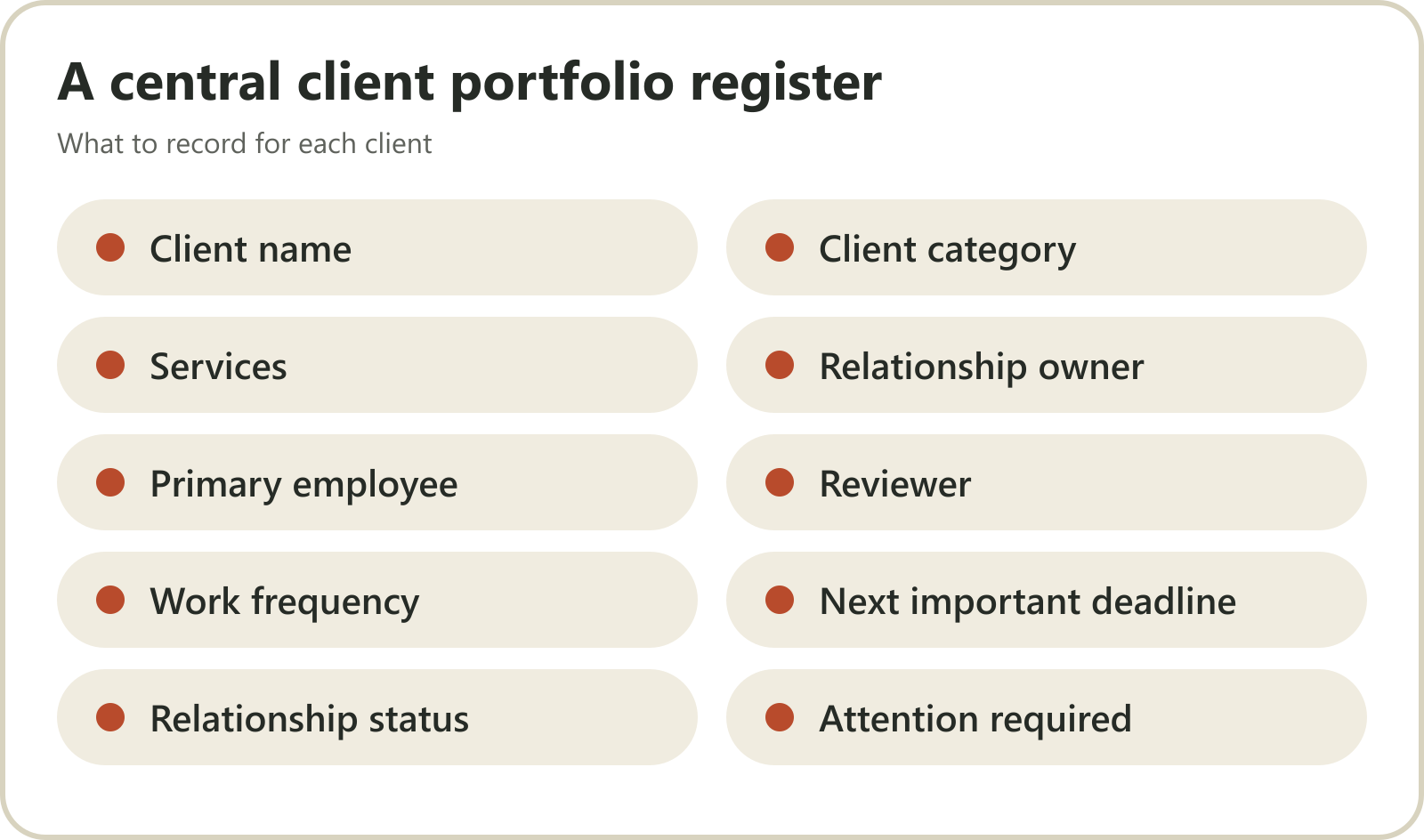
This register becomes the foundation of client portfolio management.
It should help management answer:
How many active clients does the firm currently serve?
Which services does each client receive?
Who is responsible for each relationship?
Which clients have work requiring attention?
Which clients have upcoming deadlines?
Which assignments are currently pending?
Important: A client list should not become another spreadsheet that employees update inconsistently. It needs a defined owner and a regular review process.
3. Organise clients by service category
Managing every client in the same way is inefficient.
A firm should group clients according to the services they receive.
For example:
| Client category | Typical services |
|---|---|
| GST clients | GSTR-1, GSTR-3B and reconciliations |
| TDS clients | Quarterly TDS statements and related work |
| Income tax clients | ITR preparation and related services |
| Company clients | GST, TDS, ROC and annual compliance |
| Accounting clients | Bookkeeping, reconciliations and financial statements |
| Audit clients | Audit planning, fieldwork and reporting |
This classification helps the firm understand its workload.
For example, if 60 clients require monthly GST services, the manager can plan the required team capacity instead of discovering the workload when deadlines approach.
It also helps identify service concentration.
If most of the firm's clients require the same recurring service, the firm can standardise that workflow and reduce unnecessary duplication.
However, client categorisation should reflect the actual services and engagement scope. Do not assume every company or business requires the same set of compliance services.
4. Assign a relationship owner to every important client
One of the most useful improvements a growing CA firm can make is separating relationship ownership from individual task execution.
Consider this example:
ABC Manufacturing Pvt. Ltd. receives:
Monthly GST services.
Quarterly TDS services.
Accounting services.
Annual audit services.
Different employees may execute different assignments.
But who is responsible for understanding the overall client relationship?
A simple ownership structure can help:
| Responsibility | Person |
|---|---|
| Relationship owner | Partner |
| Client coordination | Manager |
| GST work | Employee A |
| TDS work | Employee B |
| Accounting | Employee C |
| Final review | Assigned reviewer |
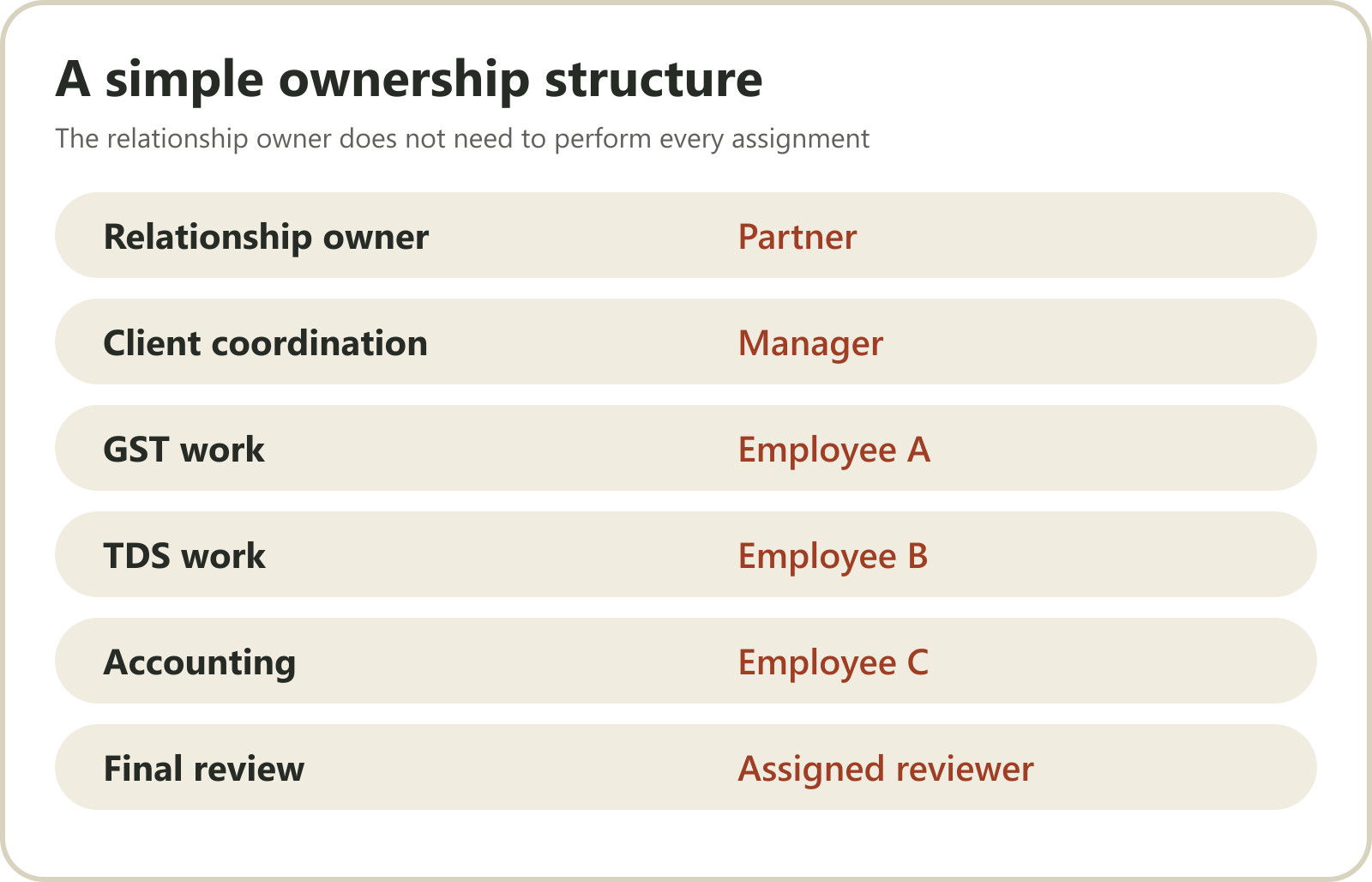
The relationship owner does not need to perform every assignment.
Their responsibility is to maintain oversight, ensure that service expectations are understood and resolve important client-level issues.
This creates continuity even when individual employees handle different assignments.
It also makes handovers easier.
If Employee A is unavailable, another team member can understand the client's outstanding work through the firm's records rather than relying entirely on personal conversations.
5. Manage clients through service-wise workflows
Every client relationship may involve multiple services.
The firm should avoid treating the entire client as one large task.
Instead, divide the client's work into individual service workflows.
For example:
Client: ABC Manufacturing Pvt. Ltd.
| Service | Frequency | Responsible team |
|---|---|---|
| GST compliance | Monthly | GST team |
| TDS compliance | Quarterly | TDS team |
| Accounting | Monthly | Accounts team |
| Annual audit | Annually | Audit team |
| ROC compliance | As applicable | Corporate compliance team |
Each service should have its own:
Scope of work.
Responsible employee.
Reviewer.
Internal milestones.
Applicable deadlines.
Completion criteria.
This is particularly important when the same client receives multiple services.
Without service-wise visibility, one completed assignment may create the impression that the entire client account is up to date.
For example, GST work may be complete while accounting reconciliation is still pending.
A service-wise view prevents these activities from being confused.
6. Standardise recurring work across clients
Recurring services are a major part of many CA practices.
The same basic workflow may need to be repeated for dozens or hundreds of clients.
Instead of designing every monthly assignment from scratch, create reusable workflow templates.
For example, a monthly GST workflow might contain:
Confirm applicable service and period.
Check required information and documents.
Assign preparation work.
Complete reconciliation and internal checks.
Send work for review.
Resolve review observations.
Complete the firm's filing process.
Record completion and relevant follow-up.
The precise steps should reflect the firm's professional procedures and the client's circumstances.
Once the template is approved, the firm can reuse it for relevant clients.
A similar approach can be used for accounting, TDS, audit preparation and other recurring services.
Why templates matter
Without templates:
Employees repeatedly create similar assignments.
Different teams may follow different processes.
Important internal steps may be overlooked.
Managers spend time explaining the same workflow.
With templates:
The process becomes repeatable.
Responsibilities can be assigned consistently.
Internal deadlines become easier to monitor.
New employees can understand the workflow more quickly.
The aim is to standardise routine coordination while retaining professional judgement for client-specific work.
7. Build a client-wise priority system
Not every client needs the same level of attention every day.
A firm should have a way to identify which clients need immediate action.
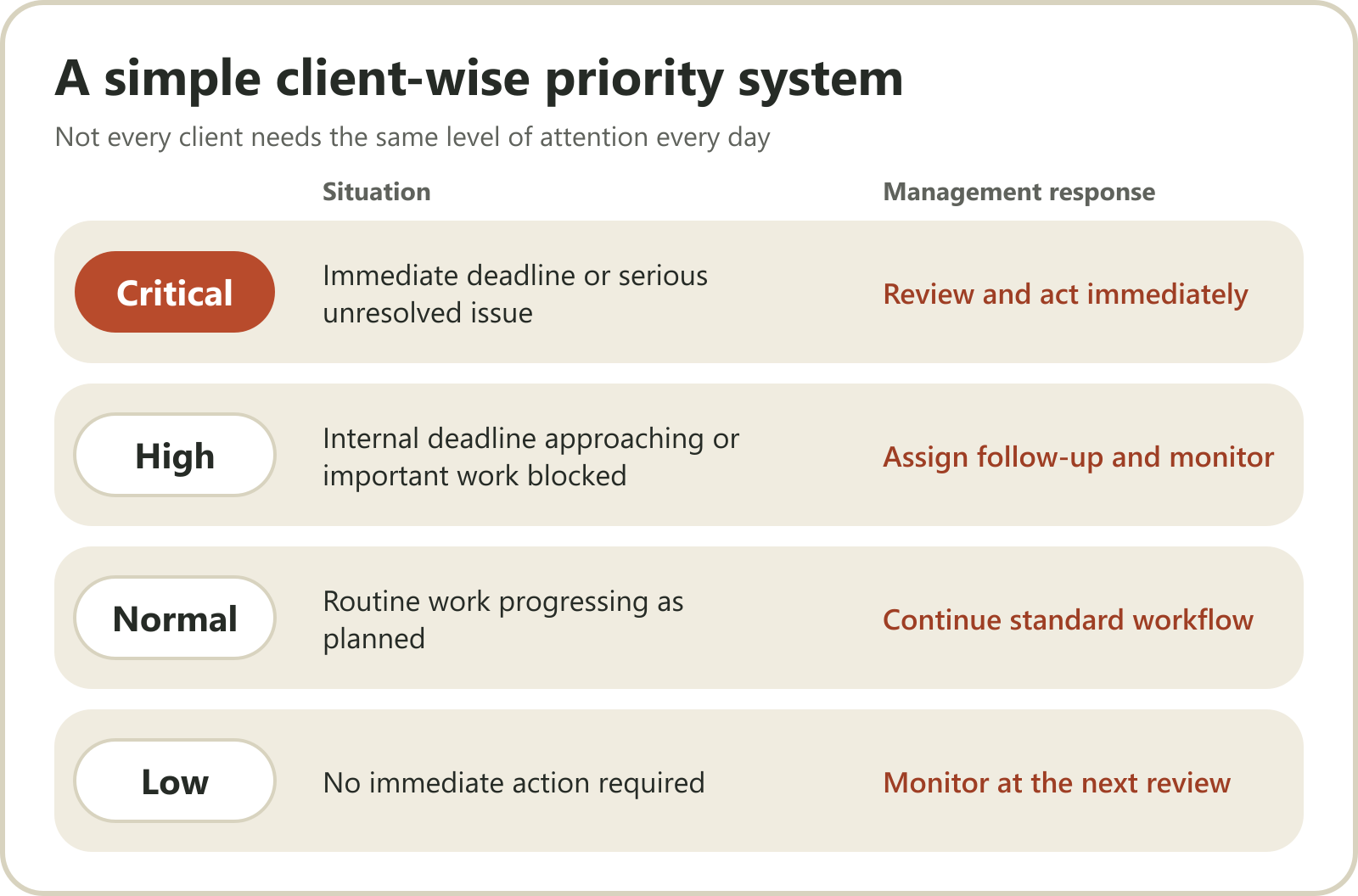
A simple priority system can work well.
| Priority | Situation | Management response |
|---|---|---|
| Critical | Immediate deadline or serious unresolved issue | Review and act immediately |
| High | Internal deadline approaching or important work blocked | Assign follow-up and monitor |
| Normal | Routine work progressing as planned | Continue standard workflow |
| Low | No immediate action required | Monitor at the next review |
For example:
ABC Traders has a deadline approaching and an unresolved issue.
XYZ Ltd. has completed its current assignments.
PQR Enterprises is waiting for information before work can proceed.
These clients should not receive identical management attention.
A useful client dashboard should make exceptions visible without requiring the partner to inspect every individual assignment.
One important distinction: A client may have a high priority without every assignment for that client being urgent. Priority should be attached to the actual issue or work item wherever possible.
8. Introduce a weekly client portfolio review
Most firms review individual assignments when deadlines approach.
However, partners should also review the health of the overall client portfolio.
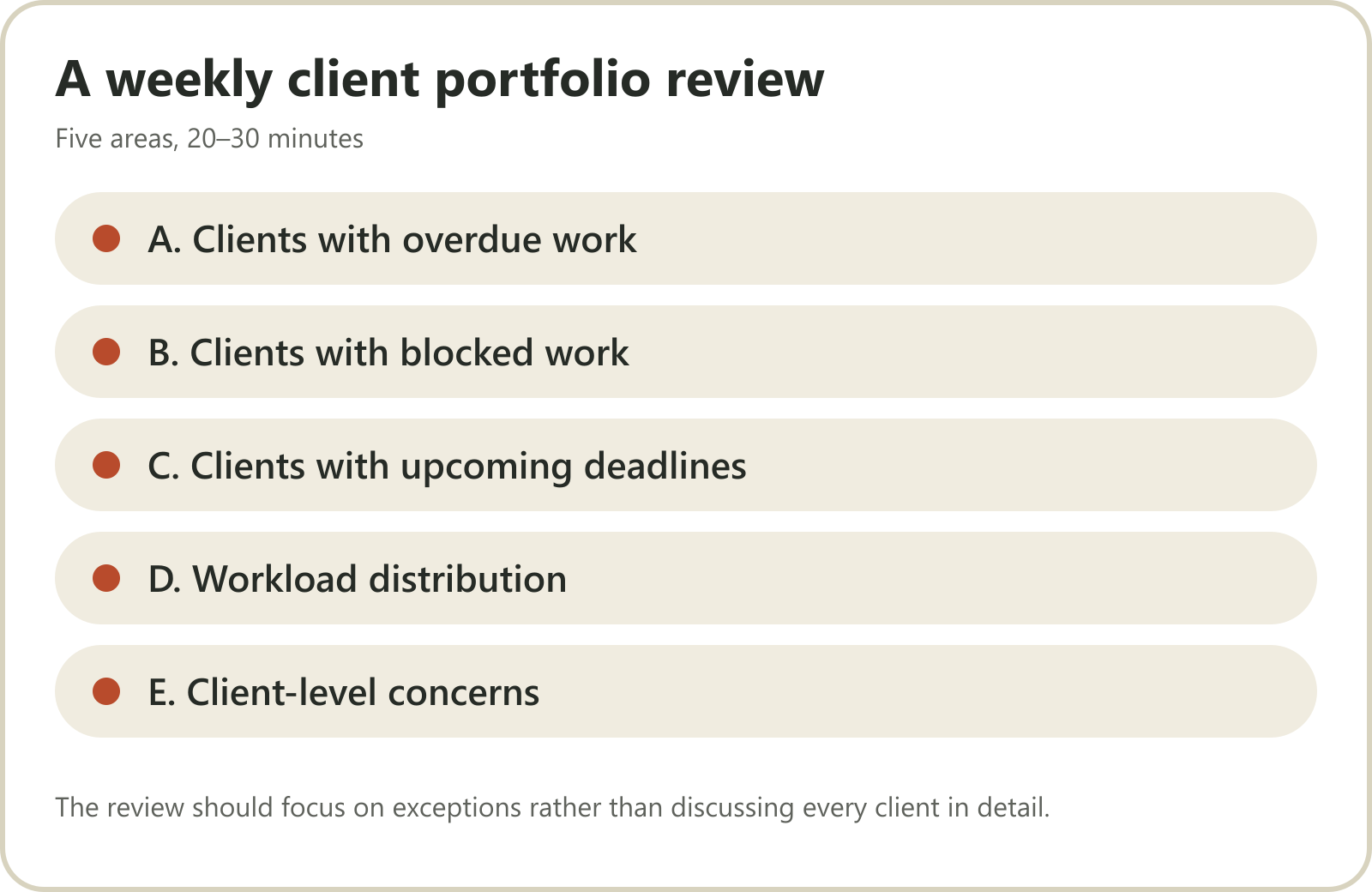
A weekly review of 20–30 minutes can help identify problems early.
Consider these five areas:
A. Clients with overdue work
Which clients have assignments that missed their internal deadlines?
B. Clients with blocked work
Which clients are waiting for documents, clarification, approvals or other dependencies?
C. Clients with upcoming deadlines
Which client assignments need attention over the next seven days?
D. Workload distribution
Are certain employees handling too many clients or assignments?
E. Client-level concerns
Are there unresolved service issues, communication problems or matters requiring partner attention?
The review should focus on exceptions rather than discussing every client in detail.
For example, if a firm manages 200 clients, there is little value in spending time reviewing all 200 every week.
Instead, review the 15–20 clients that need attention, along with important upcoming work.
This keeps the meeting practical.
9. Monitor client workload and team capacity together
A growing client portfolio does not automatically mean the firm can handle additional work.
Before accepting more assignments, management should understand the workload already being handled by its employees.
For example:
| Employee | Active clients | Workload observation |
|---|---|---|
| Employee A | 18 | High number of monthly assignments |
| Employee B | 12 | Handling complex audit work |
| Employee C | 22 | Mostly routine recurring work |
| Employee D | 10 | Available for additional assignments |
These figures are illustrative. The number of clients alone does not determine workload.
A client requiring only one annual service is very different from a client requiring multiple monthly services.
Therefore, evaluate workload using:
Number of active assignments.
Complexity of services.
Time required.
Upcoming deadlines.
Review responsibilities.
Employee experience and capability.
Recorded hours where available.
This information helps managers distribute work more intelligently.
It also helps partners decide whether the firm has the capacity to accept new engagements.
ICAI's guidance on client acceptance and continuance under SQC 1 highlights the importance of considering whether a firm has the competence, capabilities, time and resources to undertake or continue an engagement. Client portfolio planning should support that professional responsibility, not replace it.
10. Maintain continuity when employees change
A client relationship should not depend entirely on one employee remembering everything.
Consider what happens when an employee leaves the firm.
The manager may need to find out:
Which clients were assigned to the employee?
Which services were being handled?
What work was completed?
Which assignments remain pending?
What information is awaiting review?
Are there unresolved client issues?
If this information exists only in individual WhatsApp conversations, the handover becomes difficult.
A better process is to maintain structured work records.
For each active client assignment, the firm should be able to identify:
The responsible employee.
The current status.
The last meaningful update.
The next action.
The internal deadline.
The reviewer, where applicable.
Before an employee changes roles or exits, conduct a formal handover covering active assignments and relevant client responsibilities.
This protects operational continuity and reduces unnecessary disruption.
11. Use technology to manage the client portfolio
Spreadsheets can be useful when a firm has a small client base.
However, as the number of clients, employees and recurring assignments increases, manual coordination becomes harder.
A suitable practice management system should help the firm connect client work with the people responsible for completing it.
Look for capabilities such as:
Client-linked task assignment.
Recurring project templates.
Clear task ownership and deadlines.
Progress updates.
Employee follow-ups.
Work logs by client.
Review and approval workflows.
Management dashboards.
Visibility into pending and blocked work.
The objective is to create one operational view of client work instead of relying on multiple disconnected trackers.
Why WhatsApp-first workflows can help
In many Indian CA firms, employees already communicate through WhatsApp.
The problem is not necessarily communication. It is converting communication into reliable operational information.
For example:
A manager assigns a task to an employee.
The employee receives the assignment through WhatsApp. Later, the system asks for an update. The employee responds in natural language.
A suitable system can convert that response into a structured task update linked to the relevant client and assignment.
The manager can then see what has progressed and what requires attention through a central dashboard.
This reduces dependence on employees manually updating multiple trackers.
12. How Karyai helps CA firms manage client-wise work
Karyai is AI-powered practice management software built for Indian professional firms, including CA and CS firms.
Its approach focuses on connecting employee communication, task management and recurring client work.
Rather than requiring employees to constantly update a separate tracker, Karyai uses WhatsApp-based workflows to collect progress updates and help managers see what is happening across the practice.
Relevant capabilities include:
1. Client-linked task tracking
Tasks can be connected to clients, assigned owners and deadlines, making work easier to monitor.
2. Recurring client projects
Firms can create reusable project templates and automatically create recurring monthly projects for subscribed clients.
3. Employee follow-ups
Karyai uses AI-powered WhatsApp reminders to follow up with employees about pending work and collect progress updates.
4. Client work logs
Employees can record time against client work, helping managers understand recorded hours by client and employee.
5. Practice-wide visibility
Managers can view progress, pending work and assignments requiring attention without checking individual conversations.
6. Reviews and approvals
The firm can retain its review and approval processes while using AI to handle repetitive coordination.
Karyai is already being used inside a CA firm with 43 employees across 7 cities, where more than 100 client projects are created every month.
Importantly, Karyai helps organise client work and compliance workflows. It does not calculate tax, prepare statutory returns or file GST, TDS, ITR or ROC returns. The firm's professionals retain responsibility for review and filing.
You can explore Karyai's practice management software for CA firms or learn about its compliance management workflows.
13. A practical 30-day implementation plan
You do not need to reorganise your entire practice at once.
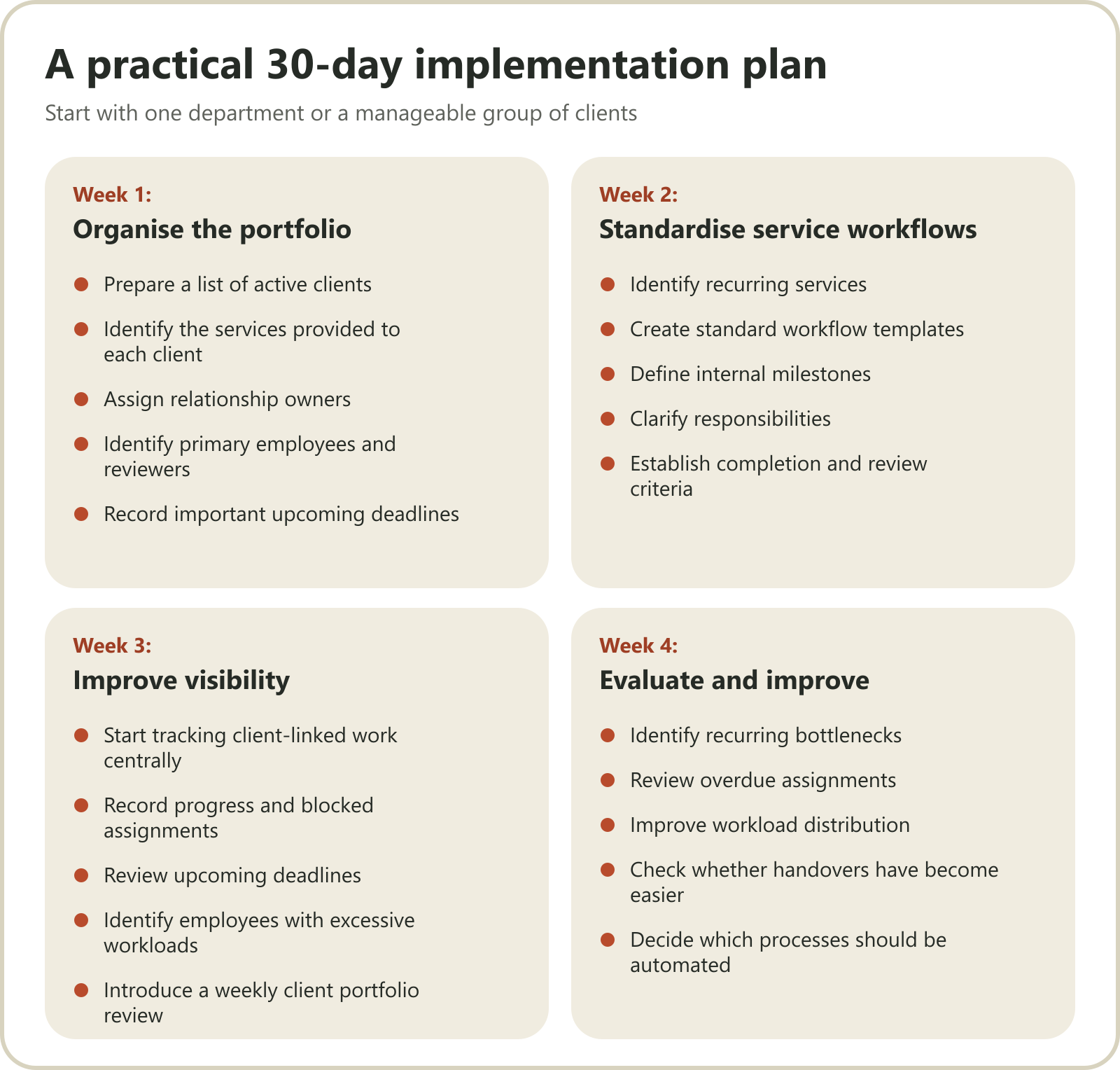
Start with one department or a manageable group of clients.
Week 1: Organise the portfolio
Prepare a list of active clients.
Identify the services provided to each client.
Assign relationship owners.
Identify primary employees and reviewers.
Record important upcoming deadlines.
Week 2: Standardise service workflows
Identify recurring services.
Create standard workflow templates.
Define internal milestones.
Clarify responsibilities.
Establish completion and review criteria.
Week 3: Improve visibility
Start tracking client-linked work centrally.
Record progress and blocked assignments.
Review upcoming deadlines.
Identify employees with excessive workloads.
Introduce a weekly client portfolio review.
Week 4: Evaluate and improve
Identify recurring bottlenecks.
Review overdue assignments.
Improve workload distribution.
Check whether handovers have become easier.
Decide which processes should be automated.
At the end of 30 days, evaluate whether partners can understand the state of client work without personally asking multiple employees for updates.
That is a much more useful measure of progress than simply having another spreadsheet.
Conclusion: Manage the portfolio, not just individual assignments
A CA firm does not become difficult to manage simply because it has more clients.
It becomes difficult when client responsibilities, services, deadlines and employee updates are spread across disconnected systems.
A structured client-wise operating process solves this problem.
Start by maintaining a reliable client portfolio, assigning relationship owners, organising services into workflows, standardising recurring work and reviewing exceptions regularly.
Then use technology to connect assignments, employee updates, recorded work and management visibility.
The ultimate objective is simple:
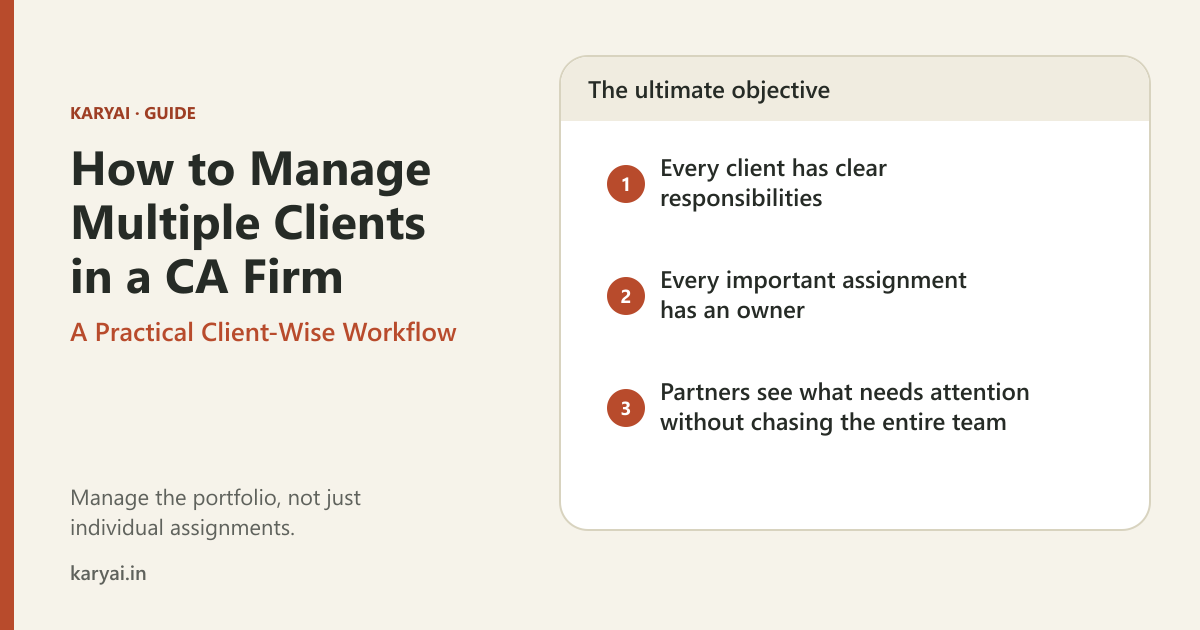
Every client should have clear responsibilities, every important assignment should have an owner, and partners should be able to see what needs attention without chasing the entire team.
Want to see how Karyai can help your firm manage recurring client projects and employee follow-ups?
Frequently Asked Questions
1. How can a CA firm manage multiple clients efficiently?
Create a central client portfolio, categorise clients by service, assign relationship owners, standardise recurring workflows and track client-linked assignments through a central system.
2. What is client management in a CA firm?
Client management involves organising client relationships, service requirements, responsibilities, ongoing assignments, deadlines and communication so the firm can deliver services consistently.
3. How should CA firms assign employees to clients?
Assign a relationship owner or manager for each important client and identify employees responsible for individual services. Keep task ownership and review responsibilities clear.
4. How can a CA firm track work across hundreds of clients?
Use client-linked assignments, recurring project templates, deadlines, progress statuses and management dashboards. Review exceptions instead of manually inspecting every assignment.
5. How can CA firms avoid missing client deadlines?
Create recurring workflows, assign owners, establish internal deadlines ahead of statutory deadlines and introduce reminders and escalation rules for work that is delayed.
6. What is the difference between client management and task management?
Client management provides an overall view of the relationship and services provided. Task management focuses on individual assignments, their owners, deadlines and progress. Both are needed to manage a growing CA practice.
7. Can software help manage multiple clients in a CA firm?
Yes. Suitable practice management software can connect client work, task assignments, recurring projects, employee updates and management dashboards in one operating system.
8. How does Karyai help with client management?
Karyai connects client-linked tasks, recurring client projects, employee WhatsApp follow-ups, work logs and management visibility. It helps firms coordinate operational work without requiring employees to maintain multiple separate trackers.